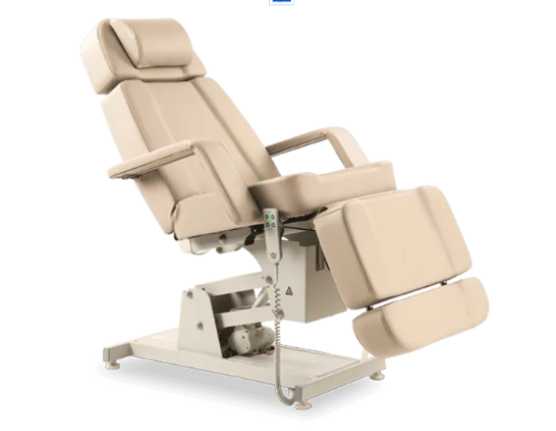
Some procedures run for hours. A hair transplant can stretch past six. An extended laser session or a careful excision keeps the patient in one place for a long stretch. The chair underneath them stops being furniture and starts shaping how the whole session goes. A good derma chair stays out of your way. A poor one keeps interrupting, and by the third hour, both you and the patient feel the inconvenience.
That is why the derma chair you pick for long work deserves more thought than a quick spec comparison. The wrong choice does not announce itself on day one. It shows up slowly, in aching backs and restless patients who will not stay still. This is what counts when the clock keeps ticking.
What Long Procedures Demand From a Derma Chair
Short appointments forgive a lot. A patient sits, the doctor works for ten minutes, and nobody notices the chair. Long procedures strip that forgiveness away.
Over several hours, small problems turn serious. A backrest set at a slightly wrong angle becomes a patient who shifts every few minutes. A height that forces the doctor to lean leaves a neck that aches by evening. A chair that felt fine in a quick demo can wear down a practitioner across a full surgical day. So the features worth paying for are the ones you only feel after two hours.
Programmable Derma Chair Positions Keep a Session Moving
Think about resetting the chair by hand every time you need a new angle. Now do that fifteen times in one procedure. Those lost minutes pile up, and each pause pulls your focus off delicate work.
A programmable handset answers this. You set the positions you use most, save them, and recall each one with a press. The Mridul Derma Chair carries this kind of handset, so a practitioner moves between saved angles without stopping to readjust by hand. During a long procedure, steadiness matters more than it sounds. Your attention stays on the patient, not on the controls.
Smooth Tilt And Height Protect the Practitioner
This one gets ignored until a career starts to hurt. A doctor bent over at an awkward height for six hours pays for it in the back and the shoulders. Repeat that week after week, and the toll builds quietly.
A derma chair with motorised height and electronic tilt lets you bring the treatment area up to you, instead of folding yourself around the patient. The Mridul Derma Chair runs on four motors, so height, backrest, leg rest, and tilt each move on their own. Set the patient where your hands sit naturally and stay there. A chair that locks you into a strained posture costs more than it saves. The price lands later, in physiotherapy bills and stiff mornings.
Patient Comfort Keeps the Treatment Field Still
A still patient is a precise procedure. A patient who aches or goes numb keeps shifting, and that movement is how small mistakes slip into careful work.
Long sessions test comfort in a way short ones never do. Pressure builds on the same spots, circulation suffers, and a patient who felt fine at the start begins to squirm. Contoured padding spreads that pressure and lets the patient lie still for hours. When the patient stays relaxed, your field stays steady.
Comfort over a long procedure really comes down to a few things:
- Even contoured padding that spreads pressure instead of concentrating it on one spot
- An independent leg rest and backrest so the patient settles into a natural position.
- A low entry height so older or anxious patients can get seated without a struggle.
- Adjustment that moves the patient gently, with no sudden jolts mid-procedure
Upholstery That Survives Repeated Deep Cleaning
Long procedures mean more fluids and harder cleaning between patients. Cheap upholstery cracks under that routine, and a cracked surface gives germs a place to hide.
Disinfectant-resistant upholstery holds up to repeated wiping with strong agents without splitting or fading. Esthetica builds its derma chairs with surfaces made for this, so the seat stays sound after months of daily cleaning. A torn chair is more than an infection worry. It tells your patient the clinic cuts corners, and that impression sticks.
See also: Expat Group Medical Insurance Is Becoming a Smarter Talent Strategy for International Employers
Why a Quick Demo Hides Long-Procedure Flaws
A ten-minute showroom test tells you almost nothing about a six-hour session. The motors feel smooth when fresh, and the padding feels soft when you press it once with your hand. Neither moment shows how the chair holds up after hours of repeated adjustment under a patient’s full weight.
So ask how the chair performs across a long procedure, not only how it looks on the floor. Push on the motors under continuous use, and on how the upholstery wears after a year of daily cleaning. The answers separate a chair built for short visits from one built for the work that keeps your clinic busy.
Choose the chair around your longest procedures. The short ones will take care of themselves. A derma chair that holds your position and stays steady under load makes every long session easier on you and safer for the patient.
