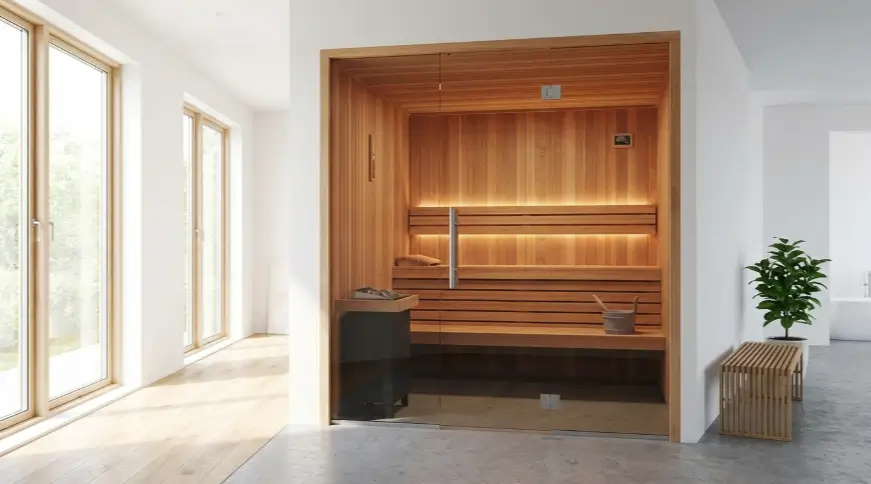
Most freestanding indoor saunas with a 6 kW heater or larger need a dedicated 240V circuit, typically on a 30 to 50 amp double-pole breaker depending on heater size. Small plug-in infrared cabins under roughly 1.8 kW are the exception and can usually run on a standard 120V outlet, which is why heater wattage, not cabin size alone, is the first thing to check before you plan the electrical work.
Step one: figure out which heater wattage your cabin needs
Heater size is driven by cubic footage, not floor space alone, since ceiling height and wall insulation both affect how much power it takes to reach temperature. A two-person indoor cabin often needs 4.5 kW to 6 kW, a four-person cabin closer to 6 kW to 8 kW, and larger family-size builds 8 kW to 9 kW or more. The heater manufacturer’s spec sheet lists the exact wattage, along with the recommended breaker size and wire gauge, and this is the number your electrician will actually work from rather than the advertised occupancy count.
Step two: confirm whether your cabin needs 120V or 240V
Anything at 6 kW or above almost always needs 240V, since running that much power over a standard 120V line would require an impractically large wire gauge and breaker. Compact plug-in infrared units are designed around lower wattage specifically so they can plug into an existing 120V outlet, which is the main reason they’re popular for apartments, rentals, and spare rooms where adding new wiring isn’t realistic. If your unit sits anywhere near that 120V ceiling, check the manual rather than assuming, since some larger infrared cabins with multiple panel zones do require 240V despite running cooler than a traditional heater.
Step three: check breaker size and wire gauge against your panel
A typical 6 kW heater calls for a 30-amp double-pole breaker on 10-gauge wire, while an 8 kW to 9 kW heater usually needs 40 to 50 amps on 6 or 8-gauge wire. Your electrician will confirm the exact numbers from the heater’s nameplate rather than a general rule, since a slightly undersized breaker can nuisance-trip and an oversized one won’t protect the wire correctly. If your panel is already close to full, this step is where you find out whether you need a subpanel or a service upgrade before the sauna project can move forward.
Step four: plan the run from the panel to the sauna room
Indoor installations often have a longer or more complicated wire run than an outdoor unit sitting near an exterior wall, since the sauna room might be in a finished basement, a converted bedroom, or a space several rooms away from the panel. Fishing new wire through finished walls, framing, or an attic space adds labor cost and is a major reason indoor sauna electrical quotes vary so much between homes. Get a walkthrough quote before buying the heater, not after, so the wiring cost is part of your real budget rather than a surprise once the cabin is already on order.
If you’re comparing cabin sizes against what your home’s electrical panel can realistically support, it helps to look at heater wattage across a few models side by side before committing to a footprint. You can browse SweatDecks indoor saunas to compare heater specs across two-person and family-size indoor builds.
Step five: confirm code requirements for GFCI and permits
Most local electrical codes classify a sauna as a wet or damp location, which generally requires GFCI protection on the circuit, and a permit with inspection is standard for new 240V work, particularly when it runs through occupied living space. Skipping the permit might save a short-term cost, but it can create real problems later with a home insurance claim or a home sale disclosure, since an unpermitted electrical addition is exactly the kind of thing a buyer’s inspector flags. NFPA and UL guidance both point to licensed installation as the standard for heater wiring, not a DIY shortcut, given the combination of high current draw and a wet-adjacent space.
See also: Low-Code Platforms for Business Innovation
Step six: decide whether a subpanel makes sense for your setup
If your main panel has no open breaker slots, or the total load calculation shows you’re close to capacity once the sauna heater is added, an electrician will usually recommend a small subpanel dedicated to the sauna room rather than a full service upgrade. A subpanel is typically cheaper than upgrading your home’s main electrical service and gives you room for a future addition, like a bathroom exhaust fan upgrade or a second circuit for sauna lighting, without going back to the main panel again. Homes built before the 1990s are more likely to need this step, since older panels were sized for lower household electrical loads than modern homes with air conditioning, EV chargers, and larger kitchen appliances all competing for the same capacity.
Ask your electrician for the load calculation in writing before signing off on any panel work. It’s a short document, but it’s the piece that tells you definitively whether a subpanel is actually necessary or whether your existing panel has enough headroom, and it protects you if a future buyer’s inspector asks how the addition was sized.
Is the extra wiring cost worth it for a traditional heater over infrared?
For many households, yes, largely because higher heat output supports the kind of longer-term, regular sauna habit that shows measurable associations with cardiovascular health in research. A Mayo Clinic Proceedings review found sauna bathing linked to a range of cardiovascular benefits, and a large cohort study reported an association between frequent sauna use and lower rates of fatal cardiovascular events. These findings describe association, not proof that a stronger heater alone drives better outcomes, but they help explain why many buyers choose to pay for the 240V circuit upfront rather than settle for a lower-wattage plug-in unit.
Frequently Asked Questions
Do all indoor saunas need a 240V circuit?
No. Most freestanding cabins with a 6 kW or larger heater need a dedicated 240V circuit, but small plug-in infrared units under about 1.8 kW are built to run on a standard 120V household outlet.
How many amps does a 240V indoor sauna circuit need?
It depends on heater wattage, but a common 6 kW heater typically needs a 30-amp double-pole breaker, while an 8 kW to 9 kW heater usually calls for 40 to 50 amps. The heater’s spec sheet lists the exact breaker size and wire gauge.
Can I run the sauna circuit myself or does it need a licensed electrician?
Most jurisdictions require a licensed electrician for a new 240V circuit and require a permit and inspection, especially when the run passes through finished walls or a shared living space. Skipping the permit can complicate insurance claims and resale disclosures later.
Does an indoor sauna circuit need GFCI protection?
Electrical code in most areas treats a sauna as a wet or damp location, which typically requires GFCI protection on the circuit. Your electrician will confirm the exact requirement for your local code cycle and heater type.
What if my home’s electrical panel does not have room for a new circuit?
A subpanel or panel upgrade may be needed if there are no open breaker slots or if the panel’s total capacity is already near its limit. An electrician can do a load calculation to confirm whether the existing service can safely support the addition.
References
- Cardiovascular and Other Health Benefits of Sauna Bathing: A Review of the Evidence, Mayo Clinic Proceedings, 2018
- Association between sauna bathing and fatal cardiovascular and all-cause mortality events, JAMA Internal Medicine, 2015
- Clinical Effects of Regular Dry Sauna Bathing: A Systematic Review, Evidence-Based Complementary and Alternative Medicine, 2018
- National Fire Protection Association, NFPA electrical safety standards
By Tom Isherwood
